Liquid cooling hoses in data centers connect equipment and carry the fluid that transports heat to heat rejection systems. Their selection must take into account the coolant, the materials in contact with it, and the hydraulic and mechanical conditions of each section.
In facilities supporting artificial intelligence and other intensive computing workloads, cooling must meet the equipment’s thermal requirements. This application alone does not determine which hose is suitable. Selection requires an understanding of its role within the installation and how the circuit it connects to operates.
Where hoses are used in the installation
In a cold plate cooling architecture, the liquid collects heat from components through heat exchangers mounted on them. Manifolds distribute the fluid within the rack, and a coolant distribution unit, or CDU, can separate this circuit from the building’s infrastructure cooling circuit.
Infrastructure connections and those inside a server have different requirements. Available space, flow rate and maintenance operations influence selection at each point. The requirements for the cooling circuit between the CDU and the IT equipment must therefore be assessed separately from those of the building’s cooling circuit.
The first question when selecting a hose is therefore where it will be installed. Before comparing materials or diameters, it is useful to identify the equipment it connects, the role of the section and the conditions it will need to withstand.
Compatibility with the coolant and its additives
Compatibility must be checked against the actual fluid formulation. A description such as “water with glycol” needs to be supplemented with the glycol type, its concentration and the additives used.
The assessment covers all wetted materials, meaning every material that comes into contact with the liquid. This includes the hose lining, connections, seals and other exposed components. All of them must be identified to assess their compatibility with the coolant in the specific circuit.
In water-based circuits, water treatment and inhibitors form part of this assessment. Compatibility between the water-based fluid and the circuit materials must be reviewed whenever new materials are introduced. Fluid quality must also be monitored during operation to verify that it remains within the intended conditions.
When requesting a hose, it is useful to provide the coolant’s technical data sheet and its operating concentration. This information allows a specific combination of fluid and materials to be assessed.
What to check before selecting a hose
The technical enquiry should bring together circuit data and installation constraints. This information helps compare proposals on a consistent basis.
- Location: equipment connected and the section’s role within the circuit.
- Coolant: trade name, composition, concentration and additives.
- Temperature: expected minimum and maximum values, including shutdown periods.
- Pressure: normal and maximum operating conditions, and potential pressure transients.
- Flow rate: required flow rate and allowable pressure drop.
- Geometry: length, routing, available space and bend radius.
- Connections: type, dimensions, materials and sealing requirements.
- Maintenance: accessibility and expected frequency of disconnection or replacement.
For distribution to the racks, the diameter must be assessed alongside the flow rate and pressure drop along the entire route. The final choice of hose diameter is therefore not determined solely by the equipment’s port diameter.
The installation drawing should also be reviewed. A seemingly adequate length may require an excessively tight bend or make a connection difficult to access. Including the planned routing in the enquiry helps define the assembly before installation.
Data Cooling Gassoflex for cooling infrastructure
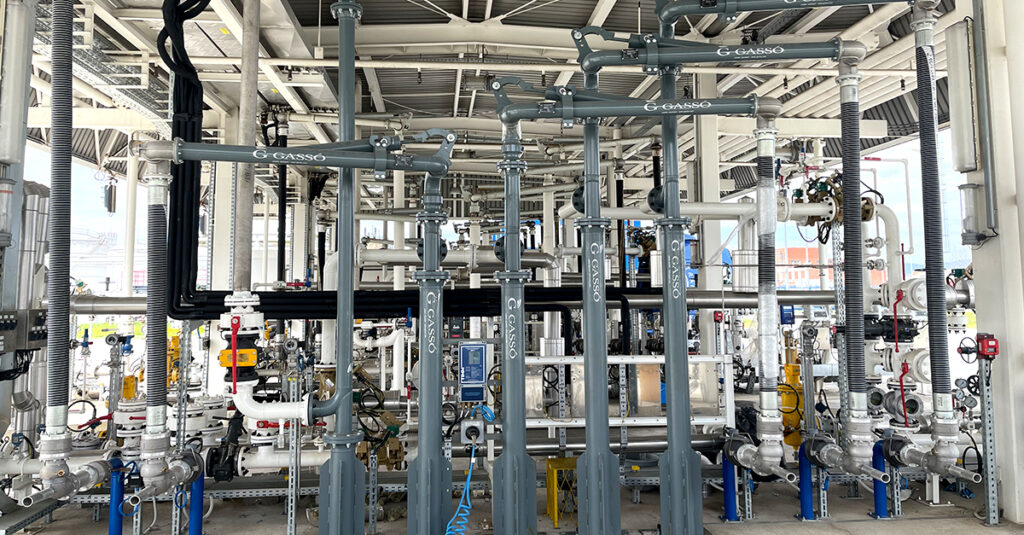
Data Cooling Gassoflex is our hose for conveying large volumes of coolant in data centers. It is designed for infrastructure applications involving CDUs, chillers and heat rejection systems, particularly where rigid piping is unsuitable.
We offer configurations for water, glycol mixtures and other heat transfer fluids. We select the materials according to the coolant and the operating conditions of each installation.
| Feature | Options and specifications |
| Inner wire helix | 304 or 316L stainless steel |
| Outer wire helix | Galvanized steel or 304/316L stainless steel |
| Inner lining | Polypropylene, PTFE or polyamide |
| Temperature range | −30 to +100 °C |
| Standard | EN 13765:2018 |
| Safety factor | 5:1 |
For each supply, we define the relevant materials, dimensions, connections and working pressure. This allows us to adapt the assembly to its location and function within the cooling infrastructure.Preparar el montaje y el mantenimiento
Planning installation and maintenance
Component selection must be accompanied by planning for circuit cleaning, filling and commissioning. Fluid quality checks and maintenance tasks must also be defined in accordance with each project’s specifications.
The supplied configuration should be clearly identified and its documentation retained from the procurement stage. Any future replacement can then be checked against the circuit’s original conditions.
To discuss a Data Cooling Gassoflex solution, contact the Gassó technical team and let us know the coolant, flow rate, expected pressures and temperatures, along with the required dimensions and connections. These details will allow us to specify the hose according to its actual role in the installation.