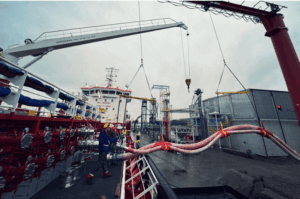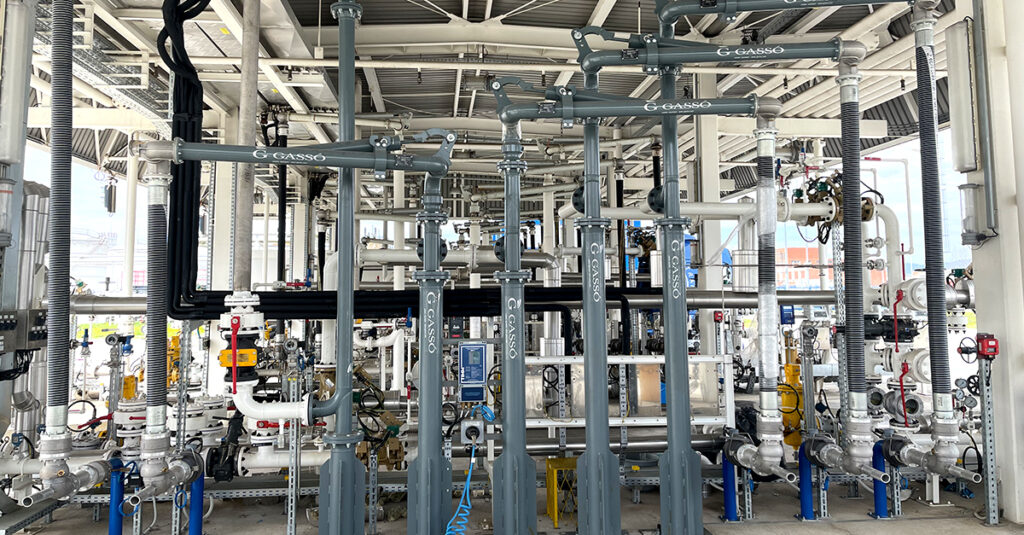
In the Liquefied Natural Gas (LNG) sector, cryogenic transfer operations require the highest standards of safety, reliability and regulatory compliance. At Gassó, we are in the final stages of certification under the EN 1472 II standard for our Gassoflex cryogenic hoses, designed for ship-to-ship (STS) operations at extreme temperatures of up to -196°C.
LNG transfer operations present unique challenges due to extreme conditions of temperature, pressure and movement. In this context, cryogenic hoses must ensure complete structural integrity, as well as controlled flexibility that allows them to absorb dynamic movements without compromising safety.
Requisitos clave en mangueras criogénicas para LNG
- Resistance to extreme temperatures: Safe and continuous operation at -196°C without any loss of mechanical properties.
- Flexibility in dynamic conditions: Ability to adapt to movements during ship-to-ship operations.
- Structural integrity: Resistance to stress, fatigue and repeated thermal cycles.
- Operational safety: Minimising the risk of leaks in critical environments.
- Regulatory compliance: Compliance with international standards such as EN 1472 II
Cryogenic hoses are not a standard component: they are a critical safety element throughout the entire LNG operation.
At Gassó, We have developed the Gassoflex Cryogenic range with a clear objective: to deliver maximum reliability under real-world operating conditions. Our development combines advanced engineering, high-quality materials and rigorous testing under extreme conditions.
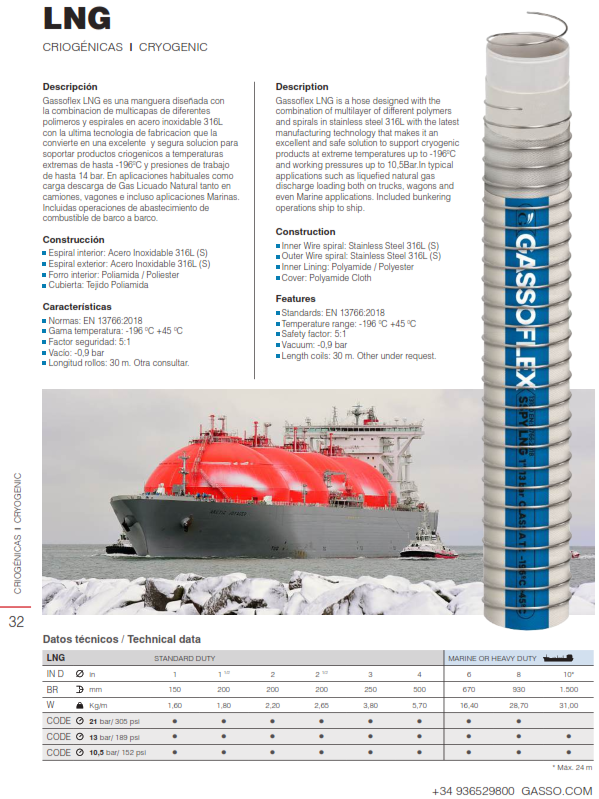
Final stage of EN 1472 Part II certification
Our Gassoflex LNG hoses are currently in the final stages of certification in accordance with the EN 1472 II standard, with the 40,000-cycle fatigue tests using liquid nitrogen currently underway
This certification validates critical aspects such as:
- Mechanical behaviour under extreme cryogenic conditions (-196 °C)
- Fatigue resistance and thermal cycling
- Safety in dynamic operation
- Long-term reliability
The leading manufacturers specialising in cryogenic transfer have set the standard for this type of solution. However, current market demands call for solutions that are increasingly efficient, reliable and tailored to real-world operating conditions.
If you are involved in LNG operations or evaluating cryogenic solutions, we can help you analyse your application and identify the best option.