In the pharmaceutical, chemical, and food industries, choosing the wrong hose can lead to everything from financial losses to safety and product quality issues. Despite this, many plant failures are not due to usage, but rather to an incorrect selection from the outset. In this article, we examine the most common mistakes made when selecting industrial hoses and how to avoid them.
In demanding industrial environments, a hose is not just a simple component, but a critical part of the process. An incorrect specification can drastically reduce service life, cause contamination, or even lead to unplanned production downtime.
Common mistakes in industrial hose selection
- Failing to consider chemical compatibility: One of the most common mistakes is failing to properly analyze the fluid being transported. Some materials can degrade, harden, or contaminate the product.
- Ignoring the actual operating temperature: Many systems operate at temperatures higher than the rated values. This reduces the hose’s service life and can lead to premature failure.
- Underestimating abrasion: In applications involving abrasive solids or fluids, choosing an unsuitable material leads to accelerated wear and frequent replacements.
- Failure to account for the radius of curvature: Incorrect installation or excessive force can cause internal stresses and structural failure.
- Choosing based on price rather than total cost: A cheaper hose may mean more replacements, more downtime and higher operating costs in the medium term.
Avoiding these mistakes improves safety, reduces operating costs and extends the service life of the facilities.
At Gassó, we analyse each application individually to recommend the most suitable solution. It’s not just about supplying a hose; it’s about understanding the entire process and minimising risks.
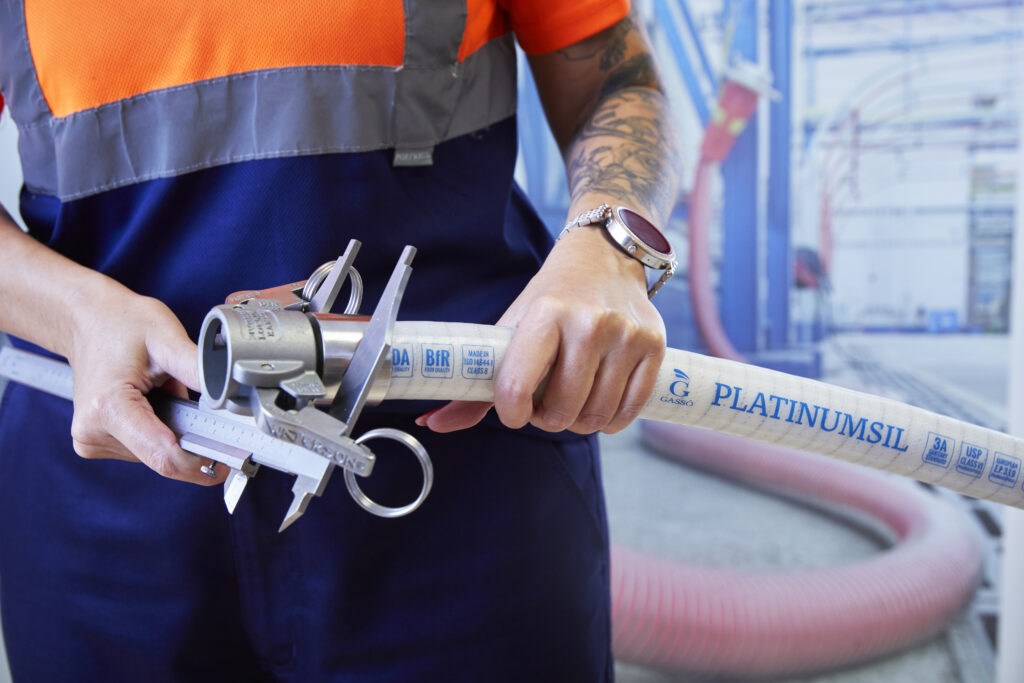
The correct selection of the right industrial hose directly impacts profitability
Keys to choosing the right industrial hoses
- Analyse the fluid: chemical composition, viscosity and potential reactions with the material.
- Define actual conditions: temperature, pressure and operating conditions (not just the nominal values).
- Assess the environment: Exposure to external factors, UV radiation, ozone or mechanical conditions.
- Consider the installation: length, radius of curvature, connections and handling.
- Choose certified materials: particularly in regulated sectors such as pharmaceuticals or food (FDA, USP, etc.).
The right choice not only prevents failures, but also optimises the system’s overall performance, reduces maintenance and improves operational safety.
With over 150 years’ experience in the field of fluid handling, our expertise and know-how are well established. Gassó is one of Spain’s leading manufacturers and an international benchmark in solutions for the transport of industrial fluids.
If you need technical advice, please contact us and we will help you find the most efficient solution for your application.
We’ll review your application and provide you with a clear recommendation within 48 hours.